
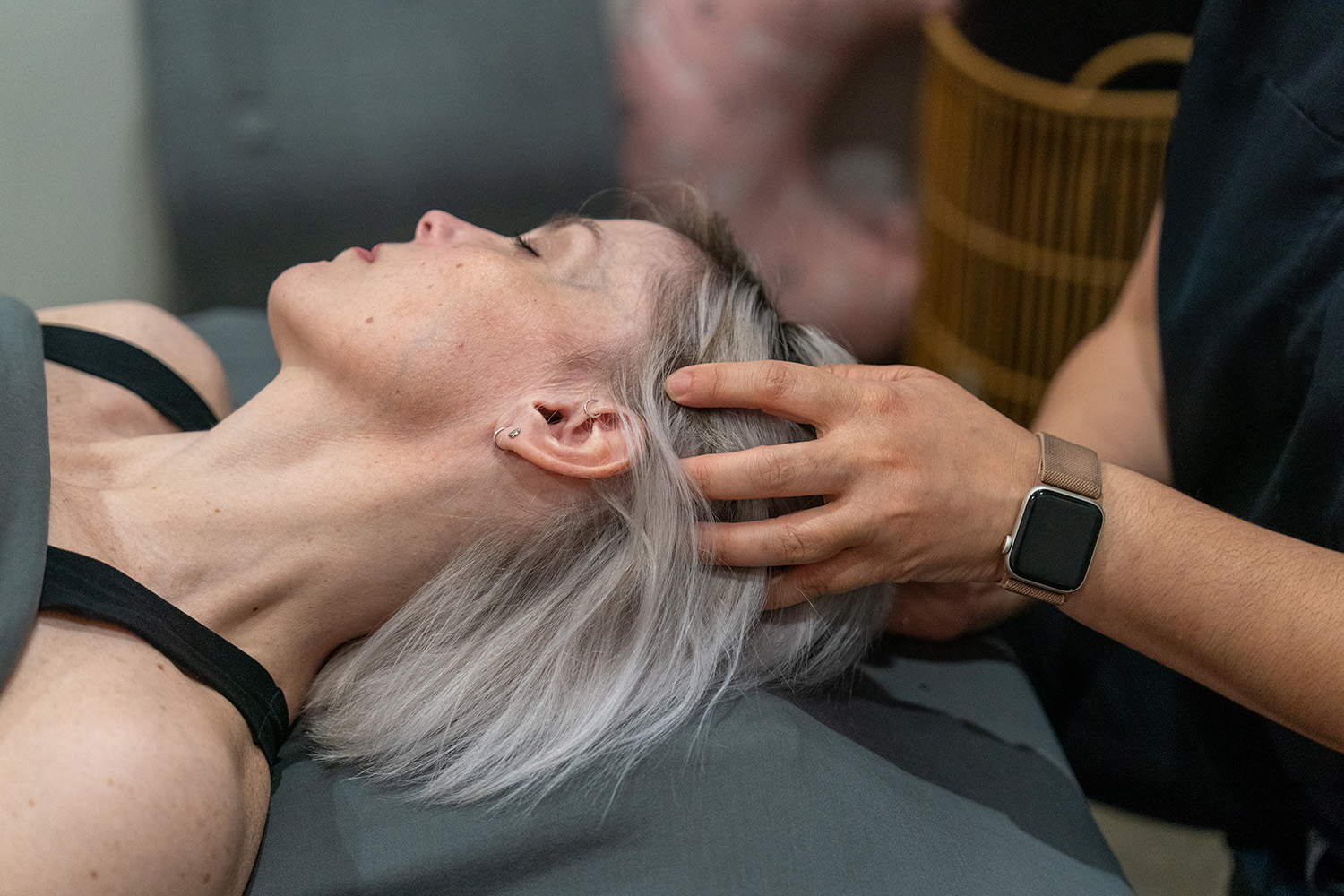
A headache starts building.
Your neck feels tight. Your shoulders are creeping upward. Turning your head feels harder than it should.
It is easy to assume one thing caused the other.
Sometimes the neck is contributing to head pain. Sometimes neck discomfort is part of the headache itself. And sometimes both are occurring at the same time for different reasons.
That distinction matters.
At Frisco Massage Therapy Recovery & Mobility, we don’t assume every headache is simply a “tight muscle” problem. Instead, we look at what you are experiencing, how your neck and shoulders are moving, where muscular tension is present, and whether massage is an appropriate part of the picture.
Headaches and Neck Pain Have a Complicated Relationship
Several different headache patterns can involve the neck and shoulders.
Tension-Type Headaches
Tension-type headaches are often described as dull, aching pressure or a feeling of tightness around the forehead, sides or back of the head.
Tenderness through the scalp, neck and shoulders can occur with them. But despite the name, current evidence does not support the old explanation that tension-type headaches are simply caused by contracting or “tight” muscles.
Researchers believe changes in pain sensitivity are also involved.
That means muscular tension may be something a person experiences alongside the headache without necessarily being its sole cause.
Migraine Can Include Neck Pain Too
This is an important distinction.
Neck pain and stiffness are common during migraine, and research increasingly suggests that the neck symptoms can be part of the migraine attack rather than the neck causing the migraine.
So having a headache and a tight neck does not automatically mean working on the neck will address the underlying headache disorder.
For clients with diagnosed migraine, massage may still feel helpful for associated muscular tension or general relaxation, but it should complement—not replace—appropriate migraine care.
Some Headaches Really Can Originate From the Neck
A cervicogenic headache is different.
This is a secondary headache in which the source of the pain originates in structures of the cervical spine or neck even though the pain is felt in the head.
These headaches can be associated with restricted neck movement, and symptoms may become worse with particular neck positions or movements.
Diagnosing a cervicogenic headache is outside a massage therapist’s scope and requires evaluation by an appropriate healthcare provider.
The important takeaway is simpler:
Head pain and neck pain can be connected—but the connection is not the same for everyone.
Why Does Your Neck Feel So Tight?
Even when muscular tension is not the underlying cause of a headache, the neck and shoulders can still become uncomfortable.
Think about how much your neck manages throughout an ordinary day.
Hours spent looking at a computer. Driving. Looking down at a phone. Training. Carrying children. Repetitive work. Stress. Sleeping in one position.
Holding the head in the same position for prolonged periods can contribute to neck discomfort, muscular tightness and reduced movement. Headaches can occur alongside those symptoms as well.
Over time, you may notice:
- Tightness through the upper shoulders
- Difficulty comfortably turning your head
- Tenderness at the base of the skull
- Tension through the sides or front of the neck
- Shoulder stiffness
- A feeling that your head is “heavy”
- Head discomfort that seems to appear after long periods at a desk or behind the wheel
Those patterns give us useful information.
They do not automatically tell us what type of headache you have.
Where Massage Can Fit
Massage is most useful when we are clear about what it can—and cannot—address.
If muscular tension, tenderness or movement restriction through the neck and shoulders is part of what you are experiencing, hands-on work may help reduce some of that muscular discomfort and make movement feel easier.
Depending on what we find, a session may include work through areas such as:
- Upper shoulders
- Muscles surrounding the shoulder blades
- Upper and mid-back
- Muscles along the neck
- Base of the skull
- Chest and anterior shoulder tissues when appropriate
The goal isn’t to find one magical “knot” responsible for the headache.
It is to address the muscular and movement components that are actually within our scope.
Research on manual therapy for headache disorders is promising but not absolute. A 2024 systematic review found improvements in pain and disability with myofascial techniques for tension-type and cervicogenic headaches, while also noting that much of the available evidence was low or very low quality. Evidence for migraine was less consistent.
That is why we prefer “massage may help” over promising that massage will eliminate headaches.
More Pressure Isn’t Necessarily Better
When your neck and head already feel sensitive, aggressively digging into every tender spot isn’t automatically the answer.
Painful pressure can cause the body to guard rather than relax.
We would rather use the amount of pressure and technique appropriate for what we are trying to accomplish.
That may mean working gradually through the shoulders, neck and surrounding areas instead of chasing the most painful spot.
It’s not how deep you go. It’s how you go deep.
Look at the Pattern, Not Just the Moment
If headaches keep returning, the pattern around them can be useful.
Consider:
- When do they typically begin?
- Do they follow long computer or driving days?
- Does neck movement feel different when they occur?
- Are you also experiencing jaw tension?
- Are headaches associated with exercise or particular activities?
- Are there migraine symptoms such as nausea or sensitivity to light or sound?
- Has the frequency or intensity changed?
Keeping track of those details can help both your massage therapist and your healthcare providers understand what is happening.
And sometimes what we notice during a massage session is a reason to recommend that you speak with another healthcare professional rather than simply scheduling more massage.
When a Headache Needs Medical Attention
Most headaches are not emergencies, but some symptoms should not be treated as routine muscular tension.
Seek prompt medical evaluation for a headache that is new, significantly different from your usual pattern, progressively worsening or otherwise concerning.
Emergency medical care is appropriate for symptoms such as a sudden severe headache or a headache accompanied by fever and a stiff neck, confusion, seizure, double vision, weakness, numbness or difficulty speaking. A worsening headache following a head injury also warrants urgent evaluation.
Massage should never be used to delay appropriate medical care.
The Bottom Line
Your neck and your head don’t operate as completely separate systems.
Muscles, joints, nerves and sensory pathways from these areas interact closely, which is one reason neck discomfort and headaches so often appear together.
But together doesn’t necessarily mean one caused the other.
Sometimes the neck is involved. Sometimes the headache is driving the neck symptoms. Sometimes muscular tension is simply another part of what your body is managing.
Our job at Frisco Massage Therapy Recovery & Mobility is not to diagnose the headache.
It is to understand the muscular and movement-related pieces we can responsibly address—and recognize when something belongs outside the massage room.
Neck and Shoulder Tension Becoming a Recurring Problem?
Therapeutic Massage allows your therapist to focus the session around the muscular tension, restricted movement and patterns you are experiencing that day.
This article is for general educational purposes and is not intended to diagnose or treat a medical condition. New, severe, persistent or changing headaches should be discussed with an appropriate healthcare professional.