
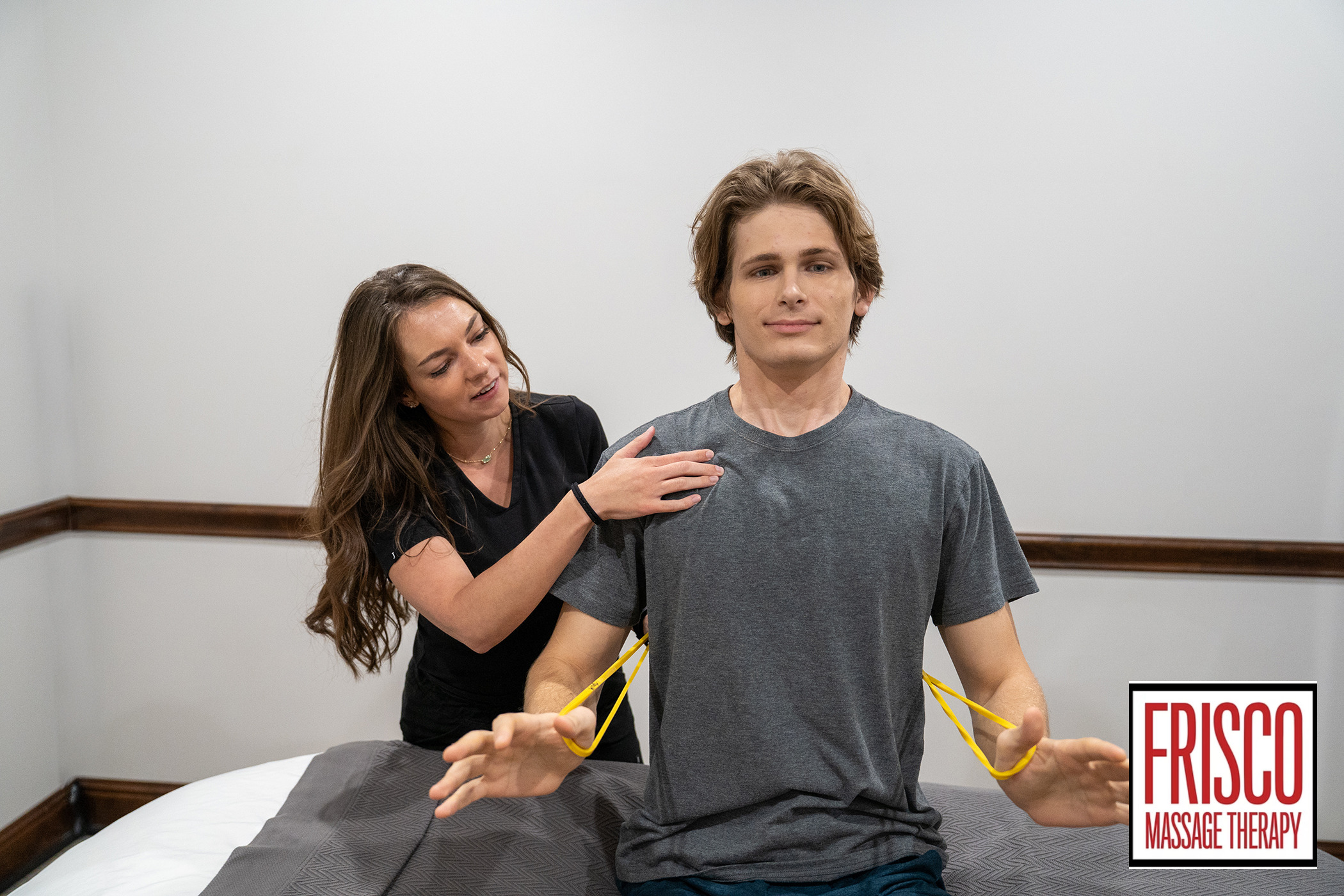
Reaching into a cabinet. Putting on a jacket. Sleeping on your side. Working at a computer. Lifting weights. Carrying groceries.
You don’t realize how much you use your shoulder until something about it stops feeling right.
Sometimes it feels painful.
Sometimes it feels tight, restricted or heavy.
Sometimes you can move your arm normally until you reach one particular angle and suddenly think, there it is.
Shoulder complaints are common, but the shoulder is also complicated. Pain in that area doesn’t automatically tell us which structure is responsible, and the exact spot where you feel discomfort may not be the only area worth considering.
At Frisco Massage Therapy Recovery & Mobility, that’s why we look beyond the sore spot.
Your Shoulder Is More Than One Joint
What we casually call “the shoulder” is actually a coordinated system.
The upper arm bone, shoulder blade and collarbone work together with the rotator cuff and numerous surrounding muscles to position and move your arm.
Your shoulder blade also has to move along your rib cage as you raise and lower the arm.
And your neck and upper back sit directly beside that entire system.
That amount of mobility is incredibly useful. It is what allows you to reach overhead, behind your back and across your body.
But it also means shoulder symptoms can have many different explanations.
Rotator cuff disorders are one common source of shoulder pain, but arthritis, frozen shoulder, joint problems, injuries and other conditions can produce pain or restricted movement as well.
This is one reason we don’t assume that every painful shoulder simply needs a tight muscle released.
Why Does My Shoulder Feel So Tight?
“Tight” is one of the most common words clients use to describe their shoulders.
It is useful information, but it isn’t a diagnosis.
A feeling of tightness can occur alongside muscular fatigue, repetitive use, reduced movement, soreness, increased sensitivity or an area that has simply been working harder than usual.
Consider what your shoulders manage during a normal week:
- Hours at a computer
- Driving
- Reaching and lifting
- Carrying children or bags
- Repetitive occupational tasks
- Strength training
- Racquet or throwing sports
- Yard work
- Sleeping in the same position
- Suddenly increasing an activity your body isn’t accustomed to
Sometimes there isn’t a dramatic injury.
The shoulder has simply been asked to tolerate more work than it was prepared for.
That distinction matters because the answer is not always “stretch the tight muscle harder.”
The Shoulder Blade Matters Too
Your arm doesn’t move independently of your shoulder blade.
As the arm moves, muscles around the shoulder blade help control its position against the rib cage while other muscles coordinate movement at the shoulder joint.
That is why a client describing shoulder discomfort may also have notable tension through the:
- Upper back
- Muscles surrounding the shoulder blade
- Upper trapezius
- Chest
- Back of the shoulder
- Neck
This does not mean that one of those areas is secretly “pulling your shoulder out of alignment.”
Human movement isn’t that simple.
It does mean that looking at how the entire shoulder region is moving and working can be more useful than repeatedly pressing on the exact location that hurts.
What About the Neck?
The neck deserves attention during a shoulder assessment too.
Symptoms coming from the cervical spine can sometimes be experienced around the shoulder or arm. Current clinical guidelines for shoulder pain specifically recommend considering cervical pain, neurological symptoms and neck dysfunction during assessment.
That doesn’t mean your shoulder pain is “really your neck.”
It means the two regions are close enough anatomically and neurologically that we shouldn’t automatically treat them as unrelated.
If symptoms include persistent numbness, tingling, notable weakness or pain traveling farther down the arm, evaluation by an appropriate healthcare provider may be warranted.
Where Massage Can Fit
Massage therapy can be useful when muscular tension, tenderness or restricted comfortable movement are part of the problem.
Depending on the individual, a session might include work through the:
- Shoulder and rotator cuff musculature
- Muscles surrounding the shoulder blade
- Upper and mid-back
- Chest and front of the shoulder
- Upper arm
- Neck
But the goal isn’t to find every tender spot and attack it.
And massage should not be presented as a way to “fix” every painful shoulder.
The 2025 clinical practice guideline for rotator cuff tendinopathy recommends active rehabilitation exercise as an initial treatment. It also states that manual therapy, including soft-tissue techniques, may be used to help reduce pain in the short term, either alone or alongside other interventions such as exercise.
That distinction is important.
Hands-on work can be part of the solution without pretending it is the entire solution.
Movement Still Matters
If your shoulder bothers you every time you reach overhead, the long-term goal usually isn’t simply to make the shoulder feel looser while you’re lying on a massage table.
You need your shoulder to function when you use it.
For many shoulder conditions, appropriate movement and progressive loading are important parts of improving function and rebuilding tolerance. Current rotator cuff guidelines emphasize individualized education, activity modification and active exercise rather than relying exclusively on passive treatment.
That might mean working with a physical therapist or another qualified healthcare professional when rehabilitation is needed.
Massage can complement that process by addressing muscular discomfort and helping make movement feel more comfortable.
Don’t Chase Perfect Posture
Shoulder discomfort is often blamed on “bad posture.”
The reality is more nuanced.
There isn’t one perfect shoulder position that everyone needs to maintain throughout the day.
The bigger issue may be spending long periods in any one position without much variation, especially when combined with repetitive workload or activities your body isn’t accustomed to.
Instead of trying to hold yourself rigidly upright all day, think about movement variability:
Change positions.
Move your arms.
Get up periodically.
Give your shoulders different things to do.
And if a particular activity repeatedly irritates the shoulder, look at the amount, frequency and intensity of that activity rather than assuming your posture is fundamentally wrong.
When Shoulder Pain Needs More Than Massage
Not every shoulder complaint belongs in the massage room.
Seek medical evaluation when shoulder pain follows a significant injury, the shoulder appears deformed or significantly swollen, you suddenly cannot move the arm, or persistent numbness or loss of sensation is present.
Shoulder or arm pain occurring with chest pressure, heaviness, shortness of breath or pain radiating toward the jaw requires emergency medical attention.
You should also consider evaluation when shoulder pain is worsening, repeatedly disrupting sleep or daily activity, producing significant weakness, or failing to improve.
Massage therapists do not diagnose rotator cuff tears, frozen shoulder, arthritis or other orthopedic conditions.
Knowing when not to treat something as ordinary muscular tension is part of responsible care.
The Bottom Line
Where you feel shoulder pain matters.
It just isn’t the whole story.
Your shoulder joint, shoulder blade, upper back, neck and surrounding muscles work together every time you reach, lift, carry or push.
So when shoulder tension or restricted movement becomes a recurring problem, we want to understand more than where does it hurt?
We want to know:
What movements bother it?
What has your shoulder been asked to do?
What feels restricted?
And which parts of that picture actually fall within what massage can help?
That’s the approach we take at Frisco Massage Therapy Recovery & Mobility.
Shoulder tension or restricted movement getting in your way?
Therapeutic Massage gives your therapist the flexibility to focus the session around the muscular tension and movement restrictions you are experiencing that day.
Book Therapeutic Massage:
https://booking.mangomint.com/friscomassagetherapy?serviceId=7
This article is for general educational purposes and is not intended to diagnose or treat a medical condition. New, severe, persistent or worsening shoulder symptoms should be evaluated by an appropriate healthcare professional.
Tighten repetitive sections and transitionsMake the massage benefits more specific