
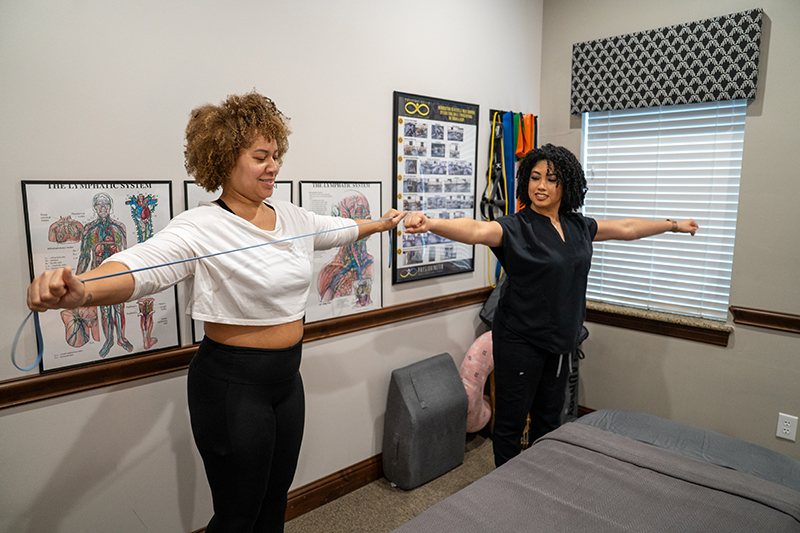
Why We Look at How You Move Before We Start Treatment
When someone comes to Frisco Massage Therapy Recovery & Mobility with shoulder tightness, limited neck movement, hip restriction, low back stiffness, or another mobility concern, we look at more than where it hurts.
One of the simplest ways to gather useful information is to look at movement.
A range of motion assessment can show how comfortably an area moves, whether one direction is more limited than another, and whether the body is compensating somewhere else. When appropriate, we can check that same movement again after treatment and compare.
It does not diagnose the cause of pain. It gives us another piece of information to help guide the session.
What Is a Range of Motion Assessment?
Range of motion refers to how far and how comfortably a joint or body region can move in a particular direction.
Depending on the concern, your massage therapist may ask you to:
- Turn your head from side to side
- Raise an arm overhead
- Rotate your shoulder
- Bend or rotate through your torso
- Move your hip or leg through a comfortable range
We may look for differences between sides, movements that feel restricted, or places where you have to shift your body to complete the motion.
That gives us a useful starting point before hands on treatment begins.
Why the Painful Area Is Not Always the Whole Picture
Pain location matters, but it does not always tell us where all of the treatment should be focused.
A client with shoulder discomfort, for example, may also have restrictions through the shoulder blade, upper back, chest, or surrounding muscles that influence how the shoulder moves.
That does not mean another area is automatically the cause of the pain. It means that looking at the movement can give us more context than working only on the exact spot that feels sore.
The same principle can apply to recurring neck stiffness, limited hip mobility, low back tightness, and movement restrictions following an injury.
How Assessment Helps Guide Treatment
Tissue tension is useful information, but it is only one part of a treatment focused session.
If a client has a specific movement restriction, assessment can help us decide which areas deserve closer attention and which techniques are appropriate for that session.
Two clients may both say their shoulder feels tight. One may have difficulty reaching overhead. Another may move normally but develop tension after long hours at a computer. The complaint sounds similar, but the treatment may be different.
At Frisco Massage Therapy Recovery & Mobility, Therapeutic Massage and Injury Recovery Therapy are individualized around the client, the problem being addressed, and what we observe during the session.
Why We Recheck Movement After Treatment
Reassessment gives us something meaningful to compare.
If turning your head to the right feels restricted before treatment, we may check that same movement again afterward.
The movement may feel easier, show greater range, or remain largely unchanged. Each response gives us useful information about how your body responded to treatment.
A change does not prove that we have identified the exact source of the problem. It does tell us whether the approach affected the movement we were trying to address and whether the next step should stay the same or change.
When Movement Assessment Is Useful
Assessment is not necessary in every massage session.
It tends to be most useful when a client has a clear mobility or functional concern, such as:
- Limited shoulder range of motion
- Neck stiffness or difficulty turning the head
- Hip tightness affecting movement or exercise
- Low back stiffness associated with certain movements
- Reduced mobility following an injury
- Recurring muscular tension in the same area
- A noticeable difference between the right and left sides
- Restrictions affecting sports, work, or daily activity
In those situations, checking movement before and after treatment can help us evaluate whether the session made a meaningful difference.
What Range of Motion Assessment Cannot Tell Us
Movement assessment has limits.
A restricted movement does not tell a massage therapist exactly which structure is responsible, and it does not replace medical evaluation when one is needed.
Pain and mobility can be influenced by many factors, including injury, joint conditions, nervous system sensitivity, previous surgery, inflammation, activity level, training load, sleep, stress, and other health conditions.
That is why we consider movement alongside your symptoms, history, activities, and goals.
If something appears to fall outside the scope of massage therapy, medical evaluation may be the more appropriate next step.
Therapeutic Massage and Injury Recovery in Frisco
If you are dealing with recurring tightness, limited range of motion, or a movement problem that is interfering with normal activity, a treatment focused massage session may be appropriate.
Therapeutic Massage is a good starting point for many clients dealing with muscular tension, persistent problem areas, and mobility restrictions.
Book Therapeutic Massage:
https://booking.mangomint.com/friscomassagetherapy?serviceId=7
Injury Recovery Therapy is designed for clients working through an injury or dealing with movement limitations associated with the recovery process.
Book Injury Recovery Therapy:
https://booking.mangomint.com/friscomassagetherapy?serviceId=9
For clients whose mobility concerns are closely connected to training or athletic activity, Sports Therapy may also be appropriate.
Book Sports Therapy:
https://booking.mangomint.com/friscomassagetherapy?serviceId=11
At Frisco Massage Therapy Recovery & Mobility, movement assessment is one of the tools we may use to better understand what a client is experiencing and make treatment more specific to the problem being addressed.
Call or text 469-756-1078 if you are unsure which service is the best fit.